AC / DC Current Sensor
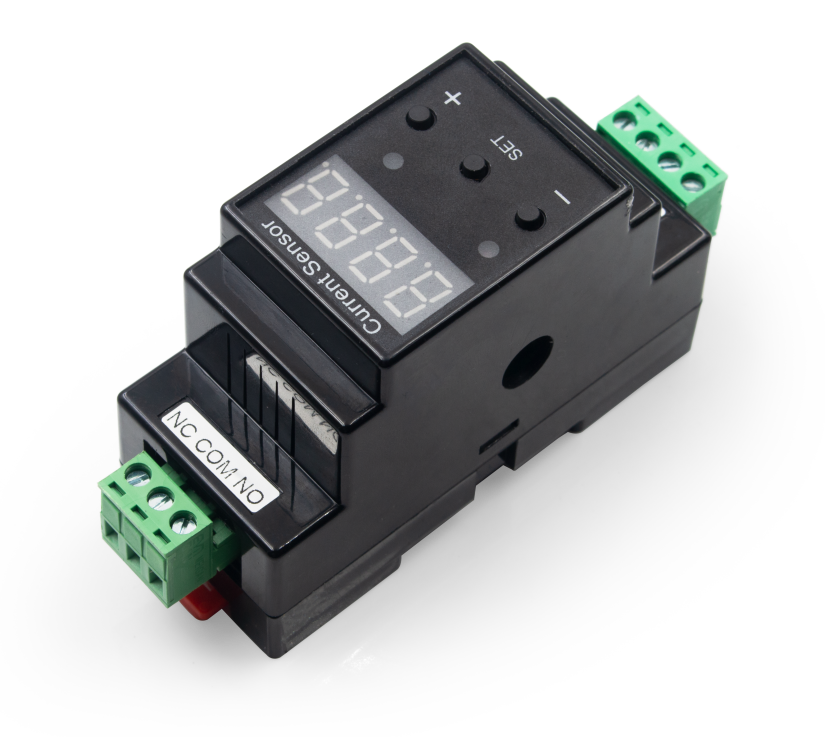
Model: LC80
Working Voltage: DC10~28V
Accuracy: ±1%F*S
Output: DC0-5V or 0-10V/RS485/Relay output.
Detect Range: AC 0-5A, 0-10A, 0-20A, 0-50A,
Description:
The Multi-functional AC/DC Current Sensor is a versatile solution designed for accurately measuring current in AC/DC circuits. With its array of built-in functions and customizable features, this module offers a reliable and flexible solution for various applications. Its high accuracy, fast response times, and user-friendly operation, making it suitable for use in power system monitoring, electric vehicle charging, smart homes, and industrial automation. Additionally, the module incorporates advanced protection mechanisms and menu-driven settings for precise control and reliable performance. Whether deployed in substations, electric vehicle charging stations, or industrial automation setups, this module delivers unparalleled performance and adaptability.
Features
- Versatile Functionality: This current sensor module offers a wide range of functions, including data acquisition, signal amplification, and filtering, allowing customers to tailor its capabilities to their specific needs.
- High-precision: The module adopts high-precision circuit design and component selection, which can realize high-precision current measurement.
- High reliability: The module adopts high quality components and strict production process, with high reliability and long life.
- Easy to use: the module has a good user interface and simple operation mode, convenient for users to use and debug.
- Strong flexibility: The module can be customized and expanded according to different application scenarios, with strong flexibility and adaptability.
Application
AC / DC current sensors measure AC / DC electrical current and find applications in various fields, including industrial settings, transportation, renewable energy, and power electronics, monitoring and controlling current flow for efficiency and safety.
- Power system monitoring: This module can be used to monitor and protect the power system, for example, in substations and power plants, through the use of current sensors to monitor and control the current, to ensure the stable and safe operation of the power system.
- Electric vehicle charging: electric vehicle charge the current in the battery pack to calculate the charging state of the battery.
- Smart home: Smart home devices also need to use current sensors, such as smart lamps, smart sockets, etc.
- Industrial automation: Industrial automation also needs to use current sensors, such as motor control, robot control, etc.
Specifications
| Working Voltage | DC10~28V |
| Power Consumption | <0.8W |
| Detect Range | AC range: 0-5A, 0-10A, 0-20A, 0-50A |
| DC range: 0-6A, 0-15A, 0-25A, 0-50A | |
| Detection Accuracy | ±1%F*S |
| Function Selection | Select the required function through the keys on the module |
| Output Method | Switching value: relay output |
| Analog signal:DC0-5V / 0-10V (self-selected) | |
| RS485:ModbusRTU-RS485 | |
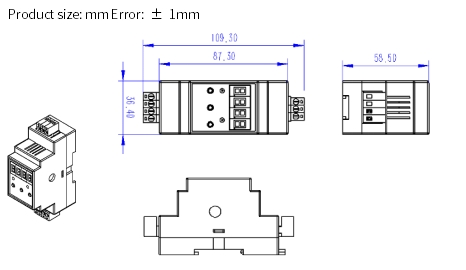
| Installation | The C45 standard 35mm guide rail is installed |
Mounting Diagrams
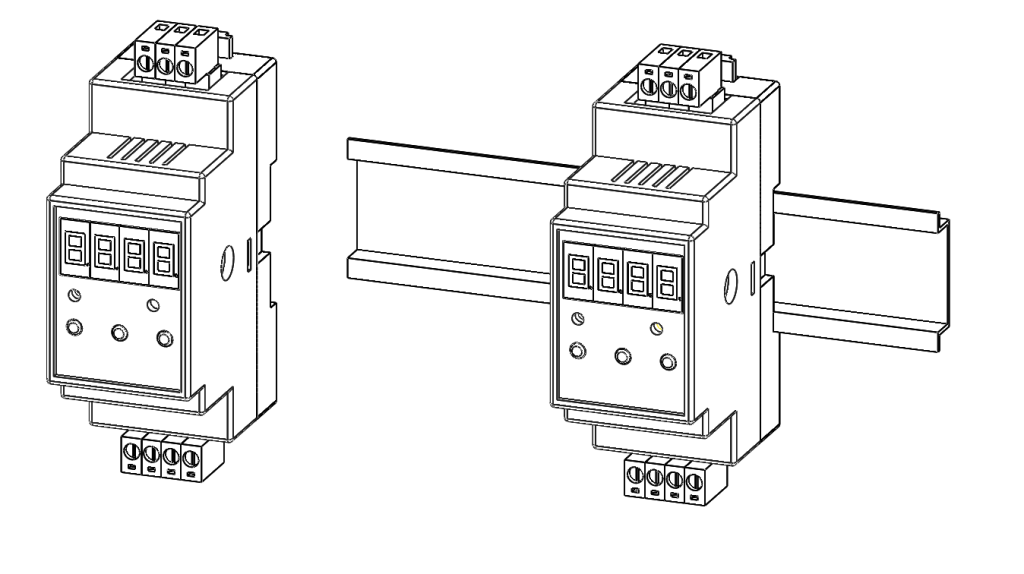
The sensor is design to mount on DIN35 35mm guide rail.
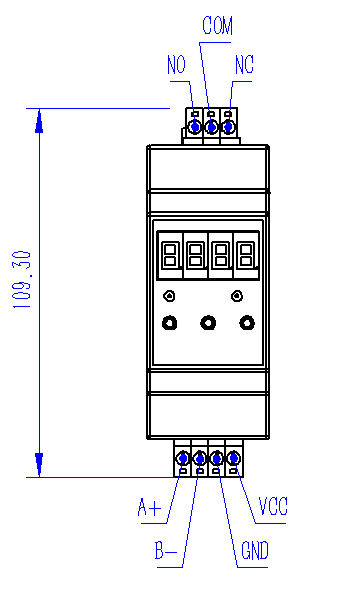
Wiring Diagram
| Port label | Description of port label | |
| Analog output type | The RS485 output type | |
| VCC | DC10~28V | DC10~28V |
| GND | Power to | Power to |
| A/+ | Analog signal output | RS485+/A |
| B/- | Simulation signal ground | RS485-/B |
| NO | Relay often begins | |
| COM | Relay public end | |
| NC | Relay often closed end | |
Selection Guide
| Product number | Measurement range | Hole diameter | Output signal |
| LC80A1 | AC 0-5A | φ4mm | 0-5V and Relay output |
| LC80A2 | AC 0-10A | φ5mm | 0-5V and Relay output |
| LC80A3 | AC 0-20A | φ7mm | 0-5V and Relay output |
| LC80A4 | AC 0-50A | φ7mm | 0-5V and Relay output |
| LC80A5 | DC 0-6A | φ8mm | 0-5V and Relay output |
| LC80A6 | DC 0-15A | φ8mm | 0-5V and Relay output |
| LC80A7 | DC 0-25A | φ8mm | 0-5V and Relay output |
| LC80A8 | DC 0-50A | φ8mm | 0-5V and Relay output |
| LC80B1 | AC 0-5A | φ4mm | 0-10V and Relay output |
| LC80B2 | AC 0-10A | φ5mm | 0-10V and Relay output |
| LC80B3 | AC 0-20A | φ7mm | 0-10V and Relay output |
| LC80B4 | AC 0-50A | φ7mm | 0-10V and Relay output |
| LC80B5 | DC 0-6A | φ8mm | 0-10V and Relay output |
| LC80B6 | DC 0-15A | φ8mm | 0-10V and Relay output |
| LC80B7 | DC 0-25A | φ8mm | 0-10V and Relay output |
| LC80B8 | DC 0-50A | φ8mm | 0-10V and Relay output |
| LC80C1 | AC 0-5A | φ4mm | RS485 and Relay output |
| LC80C2 | AC 0-10A | φ5mm | RS485 and Relay output |
| LC80C3 | AC 0-20A | φ7mm | RS485 and Relay output |
| LC80C4 | AC 0-50A | φ7mm | RS485 and Relay output |
| LC80C5 | DC 0-6A | φ8mm | RS485 and Relay output |
| LC80C6 | DC 0-15A | φ8mm | RS485 and Relay output |
| LC80C7 | DC 0-25A | φ8mm | RS485 and Relay output |
| LC80C8 | DC 0-50A | φ8mm | RS485 and Relay output |
How does an AC current sensor work?
An AC current sensor works by detecting and measuring the alternating current (AC) flowing through a conductor and converting it into a readable signal.
What happens when a current sensor fails?
When a current sensor fails, it can lead to various issues depending on the system it is part of. Here are some common consequences:
1. Inaccurate Readings: The sensor may provide incorrect current measurements, leading to improper system operation.
2. System Malfunction: Devices relying on the sensor’s data, such as motor controllers or battery management systems, may behave erratically or shut down.
3. Safety Risks: In critical systems, a failed sensor can compromise safety by not detecting overcurrent conditions, potentially causing damage or hazards.
4. Increased Wear and Tear: Without accurate current monitoring, components may operate outside their optimal range, leading to premature wear or failure.
How much power does ACS712 current sensor consume?
The ACS712 current sensor consumes very little power, as it is designed to be energy-efficient. Its power consumption primarily depends on the voltage supply and the internal resistance of its conduction path. The sensor operates on a 5V power supply and has a very low internal resistance of about 1.2 milliohms, which minimizes power loss. This makes it suitable for applications where energy efficiency is important
Which sensor can be used for DC current measurement?
To measure DC current, you can use sensors like:
1. Hall Effect Sensors: These are widely used for DC current measurement due to their ability to detect magnetic fields generated by current flow. They offer high accuracy and isolation.
2. Shunt Resistors: Measure voltage drop across a resistor to calculate current. These are simple and cost-effective but require direct contact with the circuit.
3. Current Sensors: Advanced sensors that provide isolated DC current measurement with high accuracy and minimal temperature drift.