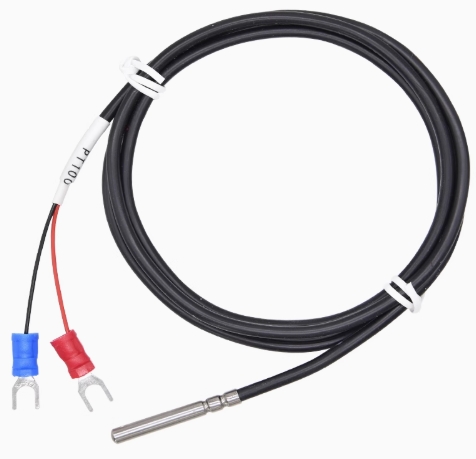
2 Wire Temperature Sensor
Model: SensorMass20250613001
Induction method: PT1000/PT100
Product type: Temperature sensor
Description:
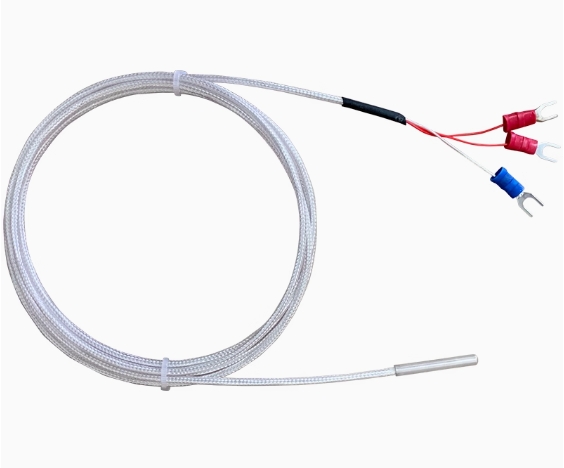
This high-performance 2-wire PT100/PT1000 temperature sensor features German-imported resistance elements for precision measurement in harsh industrial environments. Its dual-slot fixation ensures secure installation, while the oil/waterproof design (IP68 rated) guarantees durability. The sensor is paired with ultra-flexible silicone leads—reinforced with multi-strand cores—for exceptional bend resistance and easy routing during installation. Ideal for chemical plants, battery production, and CEMS monitoring, it delivers reliable readings from -50°C to 200°C with minimal signal drift.
Features
- ✔ Industrial-Grade Accuracy: German-made platinum RTD (PT100/PT1000) ensures ±0.3°C precision.
- ✔ Robust Protection: IP68 waterproof/oilproof housing + dual-slot mounting for vibration resistance.
- ✔ Superior Cable Flexibility:Multi-core silicone wires withstand 10,000+ bends without cracking or deformation.
- ✔ Easy Installation: Pre-calibrated 2-wire design with plug-and-play compatibility for fast deployment.
Application
- Electroplating plants
- Chemical plants
- Zinc smelters
- Battery manufacturing facilities
- CEMS (Continuous Emissions Monitoring Systems) gas sampling
Specifications
| Product name | 2 Wire Temperature Sensor |
| Model | SensorMass20250611S7 |
| Probe Dimensions | φ4×30mm (Diameter 4mm × Length 30mm) |
| Extend Wire Material | 2-core silicone cable |
| Temperature Range | -50°C to 200°C |

What is PT100/PT1000 indicates?
PT100/PT1000 indicates platinum resistance temperature detectors (RTDs) with 100Ω/1000Ω at 0°C
When should I choose PT1000 over PT100?
Option for PT1000 when:
High sensitivity is critical (3.8Ω/°C vs. PT100’s 0.38Ω/°C)
Measuring small temperature ranges (e.g., lab equipment, precision HVAC)
Signal stability matters in low-current applications (PT1000’s higher resistance reduces noise interference)
Can PT100 and PT1000 be used interchangeably?
Not directly. While both are platinum RTDs:
Output differences: Same temperature = 10× resistance value (PT1000=1000Ω@0°C vs. PT100=100Ω@0°C)
Compatibility: Require matched transmitters/readers calibrated for the specific type
Exceptions: Some modern controllers support both via configurable settings
Why might PT100 be preferred despite lower sensitivity?
PT100 excels in:
Wider temperature ranges (e.g., industrial processes from -200°C to +600°C)
Legacy systems where equipment is pre-configured for 100Ω@0°C
Cost-sensitive applications (typically 20-30% cheaper than PT1000)