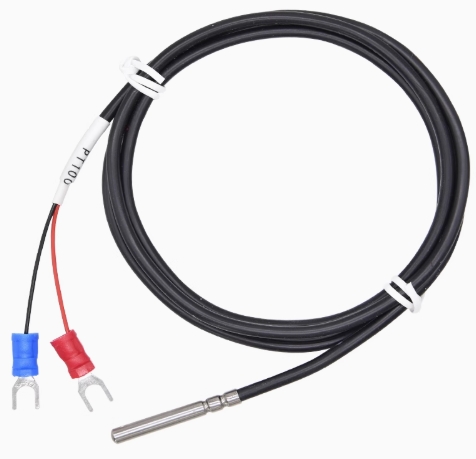
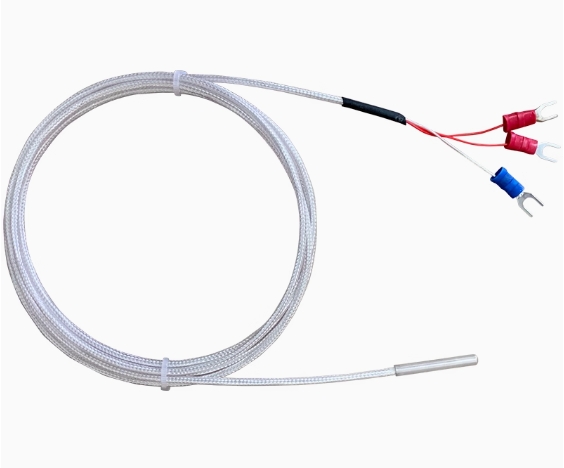
3 Wire Temperature Sensor
Model: SensorMass20250614003
Induction method: PT1000
Product type: PT1000 Temperature sensor
3 Wire Temperature Sensor , A grade
Description:
Industrial-grade PT1000 temperature sensor employs German platinum resistance elements for precise measurements (-50°C to 200°C) in harsh conditions. IP68-rated oil/waterproof housing and multi-core silicone wiring ensure vibration resistance and flexible installation. Ideal for CEMS, chemical plants, and battery production.
Features
- Elite Sensing Core:Dual accuracy classes (A/B) for precision-critical applications
- Extreme Environment Resilience: Sustains 40g vibration / 100g shock loads
- Stability Guarantee: ≤0.04% drift after 1,000 hours at 500°C;Self-heating limited to 0.4K/mW
- Plug-and-Play Compliance:Pre-configured to DIN EN 60751 (IEC 751) standards
Application
- High-Temp Process Monitoring:Industrial furnaces, chemical reactors (≤500°C);Power generation turbine exhausts
- Precision Critical Systems:Semiconductor manufacturing equipment;Aerospace component testing
- Harsh Environment Sensing:Petrochemical refineries;CEMS (Continuous Emission Monitoring)
- Automotive R&D: Battery thermal runaway testing (EV),Engine combustion analysis
Specifications
| Product name | 3 Wire Temperature Sensor |
| Model | SensorMass20250614003 |
| Probe Dimensions | φ4×50mm (Diameter 4mm × Length 30mm) |
| Extend Wire Material | 3-core silicone cable |
| Temperature Range | Class B: -70°C to 500°C Class A: -50°C to 300°C |
| Wire Material | Platinum-plated Nickel Lead Wires |
| Chip Dimensions | 2.3 × 2.1 × 0.9 mm (L×W×H) + 10mm leads |
| Insulation Resistance | 100MΩ @20°C 2MΩ @500°C |
| Measurement Current | PT1000: 0.1-0.3mA |

When should I choose PT1000 over PT100?
Option for PT1000 when:
High sensitivity is critical (3.8Ω/°C vs. PT100’s 0.38Ω/°C)
Measuring small temperature ranges (e.g., lab equipment, precision HVAC)
Signal stability matters in low-current applications (PT1000’s higher resistance reduces noise interference)
Can PT100 and PT1000 be used interchangeably?
Not directly. While both are platinum RTDs:
Output differences: Same temperature = 10× resistance value (PT1000=1000Ω@0°C vs. PT100=100Ω@0°C)
Compatibility: Require matched transmitters/readers calibrated for the specific type
Exceptions: Some modern controllers support both via configurable settings