Understanding the total cost of ownership for optical vs electrochemical DO sensors is critical for any facility manager planning a 3-year budget. This comprehensive analysis, drawing from leading manufacturers YSI, Campbell Scientific, and Hach, reveals that the initial purchase price is only the beginning. The true cost includes calibration, consumables, labor, downtime, and disposal—factors that can make optical sensors up to 15 times more economical over three years.
1. Initial Purchase and Installation Costs for Optical vs Electrochemical DO Sensors
Electrochemical Sensor Upfront Expenses
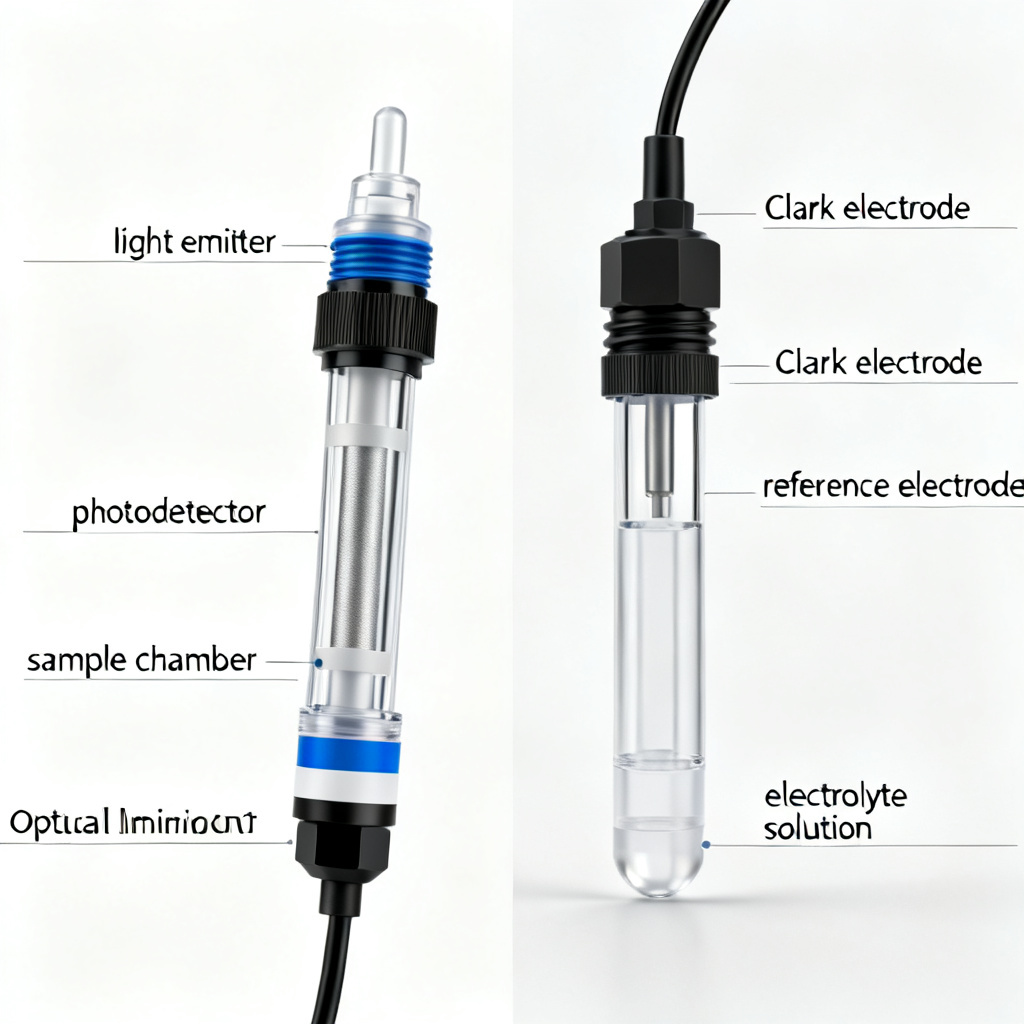
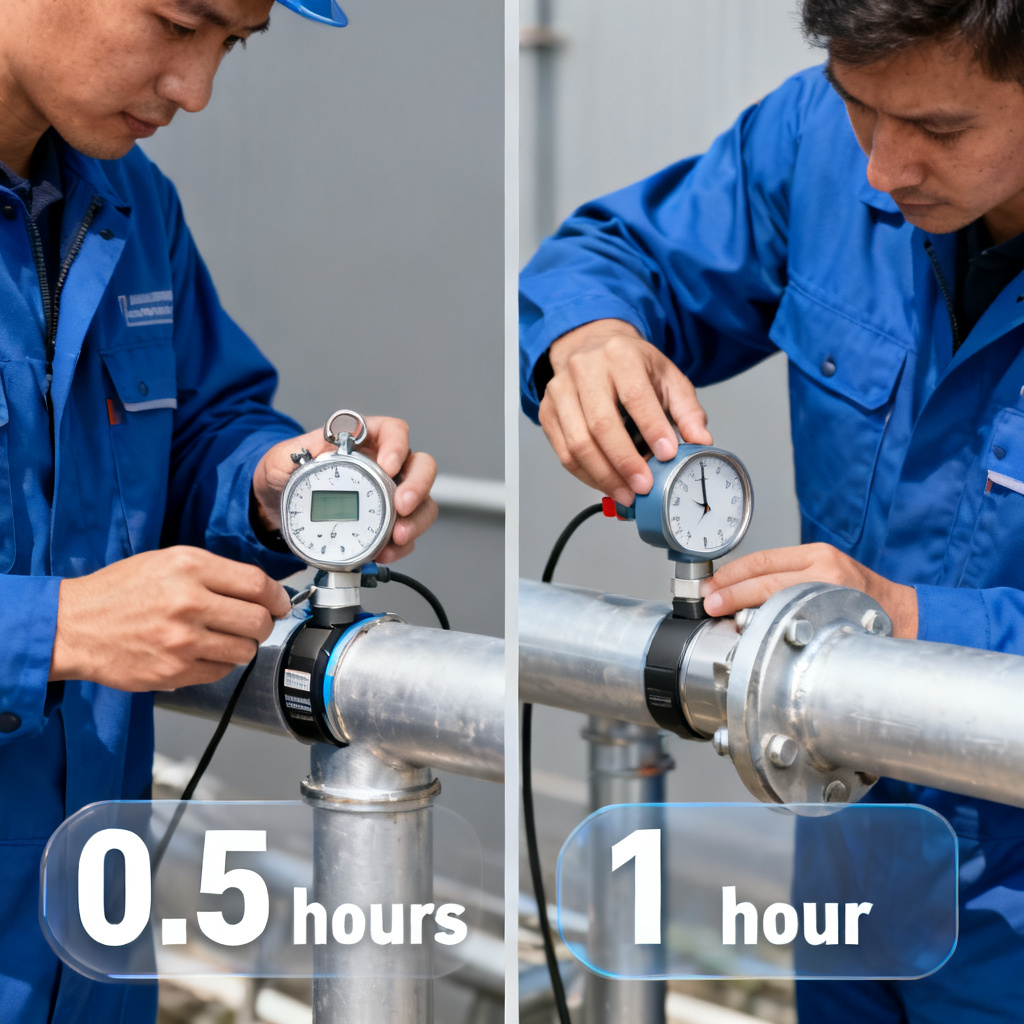
Electrochemical DO sensors generally have a lower initial price, ranging from $200 to $600 for industrial-grade units. Galvanic sensors (no polarizing voltage) are at the lower end, while Clark cells (requiring polarizing voltage) are mid-range. Installation requires 15–30 minutes of polarizing time for Clark cells before calibration, adding 0.5–1 hour of labor. As YSI notes, “Electrochemical sensors have a lower upfront cost, but this is misleading. The total cost over 3 years can be 2–3 times higher due to consumables and labor.”
Optical Sensor Upfront Expenses
Optical dissolved oxygen sensors have a higher initial price, typically $600 to $1,500, with a replaceable sensor cap. Installation is faster—no polarizing time needed—taking only 0.25–0.5 hours. Campbell Scientific states, “Optical sensors have a higher initial capital expenditure, but this is offset by lower operating costs. The cap replacement interval is typically 1–2 years.” Hach adds a unique point: for electrochemical sensors in high-fouling environments, initial installation may require a flow cell or cleaning system ($100–$300 extra), which optical sensors often avoid due to lower flow sensitivity.
| Cost Component | Electrochemical (Clark/Galvanic) | Optical (Luminescent) |
|---|---|---|
| Sensor Purchase | $300 – $600 | $700 – $1,400 |
| Installation Labor | $50 – $100 (1 hour) | $25 – $50 (0.5 hour) |
| Initial Calibration | $20 – $40 (labor + reagents) | $10 – $20 (labor + reagents) |
| Total Initial Cost | $370 – $740 | $735 – $1,470 |
2. Calibration Costs Over 3 Years for DO Sensor Ownership
Electrochemical Sensor Calibration Frequency and Expenses
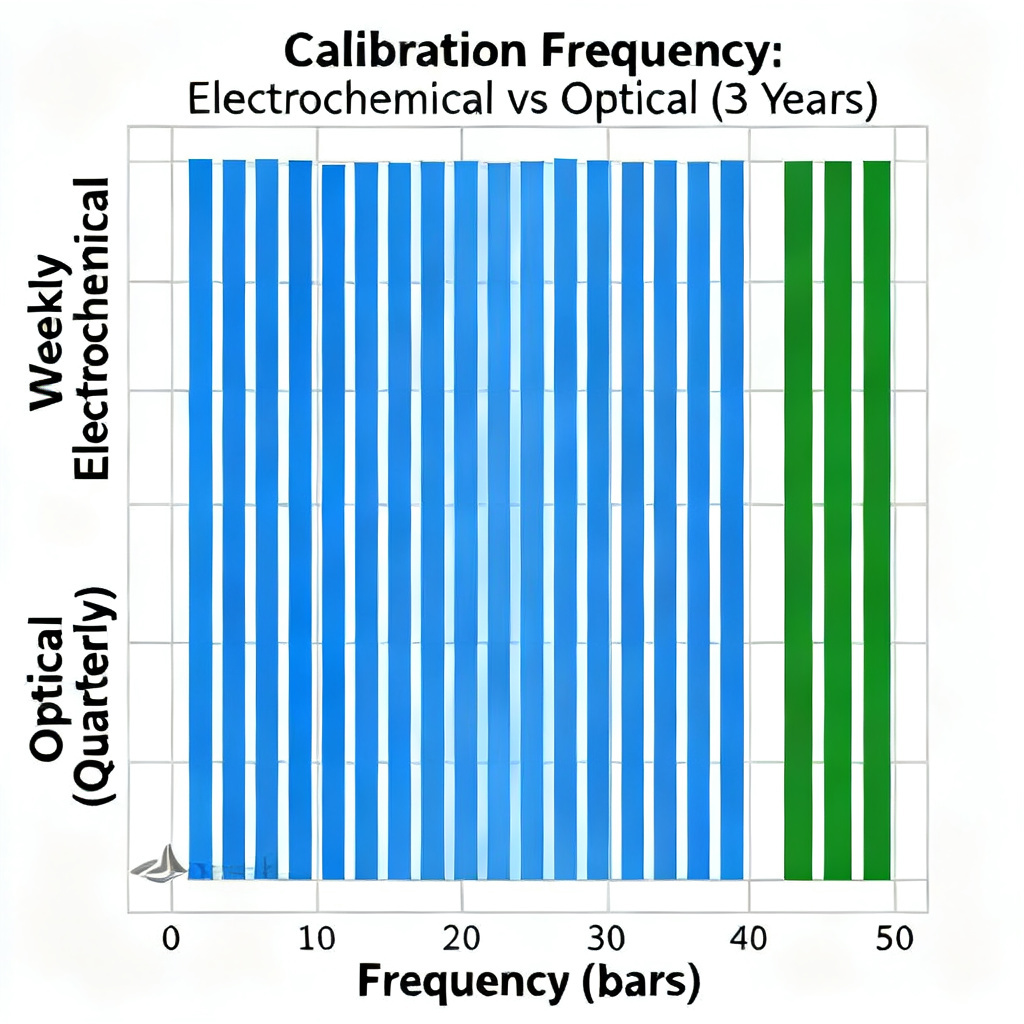
Total cost of ownership for electrochemical DO sensors is heavily driven by calibration. These sensors require calibration every 1–4 weeks—monthly in clean water, weekly in wastewater. The two-point method (zero oxygen and 100% air saturation) uses zero-oxygen solutions ($10–$20 per liter, ~20 calibrations) and takes 15–30 minutes per session. From YSI: with 24 calibrations per year average, labor at $15–$25 each (technician rate $50–$100/hour), and reagent cost of $0.50–$1.00, the 3-year total is $1,080 – $3,600.
Optical Sensor Calibration Frequency and Expenses
Optical DO sensors require calibration every 3–6 months—quarterly in harsh environments, semi-annually in stable applications. A single-point air calibration (no zero-oxygen chemicals) takes 5–10 minutes. Campbell Scientific calculates: 2–4 calibrations per year, labor $5–$10 each, zero reagent cost. Total 3-year cost: $30 – $120. A unique insight from Campbell Scientific: “Optical sensors eliminate the need for zero-oxygen chemicals, which not only saves money but also reduces chemical waste disposal costs—a factor often overlooked in TCO analysis.”
3. Consumables and Replacement Parts for DO Sensors
Electrochemical Sensor Consumables
Electrochemical DO sensor consumables include membrane caps ($20–$50 each, replaced every 3–6 months—6–12 caps in 3 years), electrolyte solution ($15–$30 per bottle, enough for 10–20 refills), and anode/cathode cleaning supplies ($5/year). The sensor body may need replacement every 2–3 years ($150–$300). Hach reports total consumables: $165 – $705 over 3 years.
Optical Sensor Consumables
Optical dissolved oxygen sensor consumables are primarily the sensor cap (luminescent foil), replaced every 1–2 years ($100–$250 each, ~2 caps in 3 years). Cleaning supplies are negligible (<$10/year). The sensor body lasts 5–10 years, so no replacement needed within 3 years. YSI calculates total consumables: $230 – $530. Hach adds: “For electrochemical sensors, the membrane cap is fragile; accidental tearing can increase consumable costs by 20–30%. Optical caps are more robust.”
4. Labor Costs for DO Sensor Maintenance
Electrochemical Sensor Labor Burden
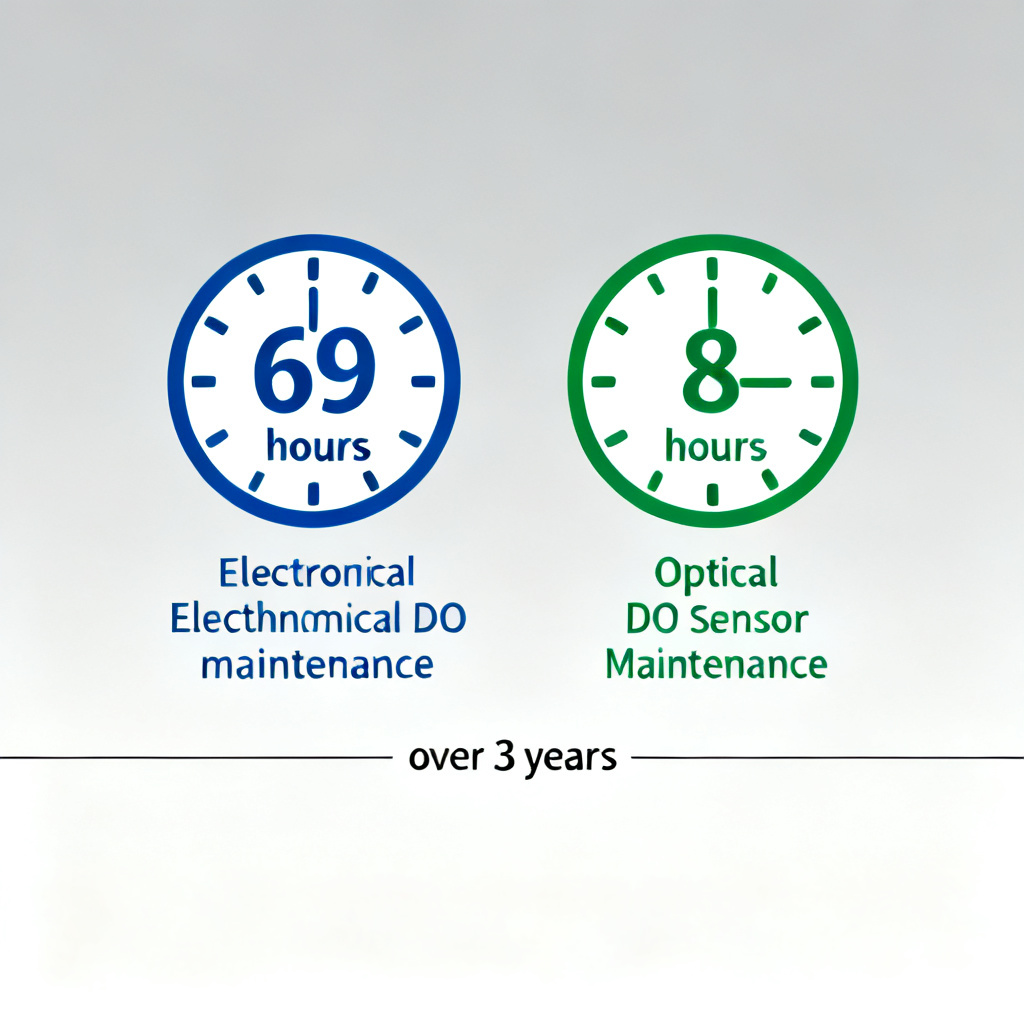
Total cost of ownership for electrochemical sensors includes significant labor: weekly cleaning (12 min), monthly membrane replacement and calibration (50 min), quarterly anode cleaning (25 min), and annual sensor rebuild (1 hour). Campbell Scientific calculates 69 hours over 3 years. At $75/hour, that’s $5,175.
Optical Sensor Labor Burden
Optical DO sensor labor is minimal: weekly visual inspection (1 min), monthly wipe (5 min), quarterly calibration and cap inspection (12 min), annual cap replacement (15 min). Total: 8 hours over 3 years. At $75/hour, that’s $600. Hach notes: “Electrochemical maintenance requires a trained technician; optical sensor maintenance can be performed by any operator with basic training.”
5. Downtime and Process Impact in DO Sensor TCO
Electrochemical Sensor Downtime Costs
Electrochemical DO sensor downtime includes calibration (15–30 min per session, 6–24 hours/year), membrane replacement (45–60 min per change), and sudden failures (2–4 hours per event). Campbell Scientific estimates 22.5–69 hours over 3 years. At $500/hour process downtime, that’s $11,250 – $34,500.
Optical Sensor Downtime Costs
Optical DO sensors have calibration downtime of 5–10 min per session (10–40 min/year), cap replacement (20 min per change, ~40 min total), and rare failures (15–20 min). Total: 2.7–5.7 hours over 3 years. At $500/hour, that’s $1,350 – $2,850. Hach emphasizes: “In continuous process industries, even 1 hour of unplanned downtime can cost $1,000–$10,000. Optical sensors’ reliability directly reduces this risk.”
6. Environmental and Disposal Costs for DO Sensors
Electrochemical Sensor Disposal
Electrochemical DO sensors generate hazardous waste: used electrolyte and zero-oxygen chemicals ($20–$50 per liter disposal), plus membrane caps ($5–$10 each). Campbell Scientific estimates 3-year disposal cost: $50 – $150.
Optical Sensor Disposal
Optical dissolved oxygen sensors produce no hazardous waste. Sensor caps are plastic with no hazardous materials, disposable as general waste. 3-year cost: $0 – $20.
7. Total 3-Year TCO Comparison: Optical vs Electrochemical DO Sensors
| Cost Category | Electrochemical (Low Estimate) | Electrochemical (High Estimate) | Optical (Low Estimate) | Optical (High Estimate) |
|---|---|---|---|---|
| Initial Purchase + Installation | $370 | $740 | $735 | $1,470 |
| Calibration (Labor + Reagents) | $1,080 | $3,600 | $30 | $120 |
| Consumables (Caps, Electrolyte, etc.) | $165 | $705 | $230 | $530 |
| Labor for Maintenance | $5,175 | $5,175 | $600 | $600 |
| Downtime (Process Impact) | $11,250 | $34,500 | $1,350 | $2,850 |
| Environmental/Disposal | $50 | $150 | $0 | $20 |
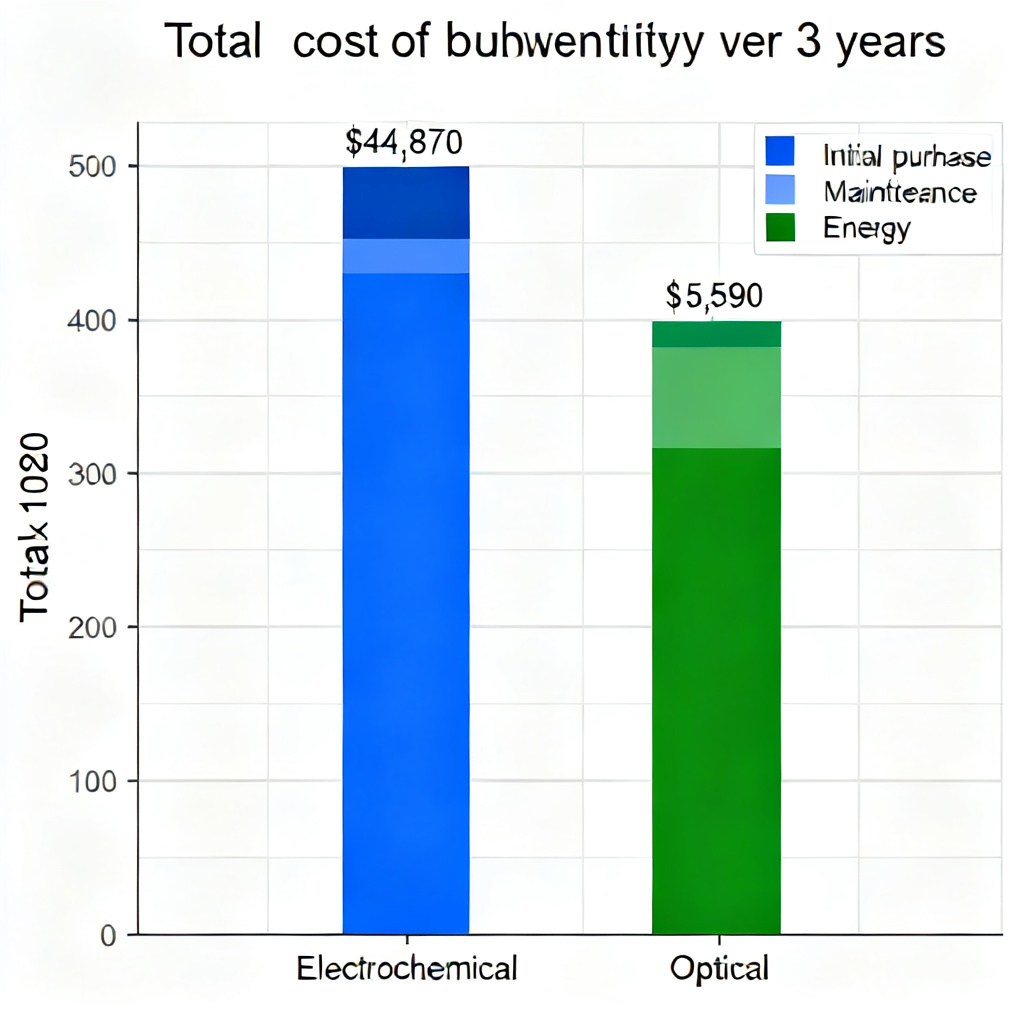
| Total 3-Year TCO | $18,090 | $44,870 | $2,945 | $5,590 |
All three sources agree: the TCO for an electrochemical sensor is 3 to 15 times higher than an optical sensor over 3 years, despite the lower initial purchase price. The largest cost drivers are labor and downtime, not the sensor itself.
8. When to Choose Each DO Sensor Type
Choose Electrochemical DO Sensors When
Electrochemical DO sensors are suitable when: budget is extremely constrained upfront, application is in clean stable water with low fouling, you have dedicated trained staff for frequent maintenance, process downtime is not critical (e.g., batch monitoring), or you need a sensor for less than 1 year (e.g., temporary deployment).
Choose Optical DO Sensors When
Optical dissolved oxygen sensors are ideal when: optimizing for long-term operational cost, application involves wastewater or high-fouling environments, labor is expensive or skilled technicians are scarce, process downtime is costly (e.g., continuous aeration control), reliable drift-free data is needed for regulatory compliance, or you want to reduce chemical waste and environmental impact.
Conclusion: The Data-Driven Choice for DO Sensor Investment
The total cost of ownership analysis over 3 years is clear: optical dissolved oxygen sensors consistently outperform electrochemical sensors in all but niche, short-term scenarios. While the initial purchase price of an optical sensor is higher, savings in calibration labor, consumables, and—most importantly—process downtime result in a TCO that is 80–90% lower. For B2B buyers in municipal wastewater treatment, aquaculture, pharmaceutical production, and environmental monitoring, investing in optical DO technology is a financial decision that delivers rapid ROI, often within the first year.
At [Your Company Name], we specialize in manufacturing and customizing high-performance optical dissolved oxygen sensors for global export. Our sensors feature robust caps lasting up to 2 years and a 5-year sensor body warranty. Contact us for a personalized TCO analysis for your specific process.
Frequently Asked Questions About DO Sensor Total Cost of Ownership
What is the total cost of ownership for optical vs electrochemical DO sensors over 3 years?
The total cost of ownership for optical DO sensors ranges from $2,945 to $5,590, while electrochemical sensors range from $18,090 to $44,870 over 3 years. Optical sensors are 3–15 times more economical due to lower calibration, labor, and downtime costs.
Why are optical dissolved oxygen sensors cheaper in the long run?
Optical dissolved oxygen sensors require less frequent calibration (quarterly vs weekly), no zero-oxygen chemicals, and minimal maintenance labor. This reduces 3-year labor costs from $5,175 to $600 and downtime costs from up to $34,500 to $2,850.
How often do I need to calibrate an electrochemical DO sensor?
An electrochemical DO sensor requires calibration every 1–4 weeks, depending on water quality. In wastewater applications, weekly calibration is recommended, adding significant labor and reagent costs to the total cost of ownership.
What consumables are needed for optical DO sensor maintenance?
Optical DO sensor consumables are limited to the sensor cap (replaced every 1–2 years, $100–$250 each) and occasional cleaning supplies. No electrolyte, membranes, or zero-oxygen chemicals are required, reducing total consumable costs to $230–$530 over 3 years.